

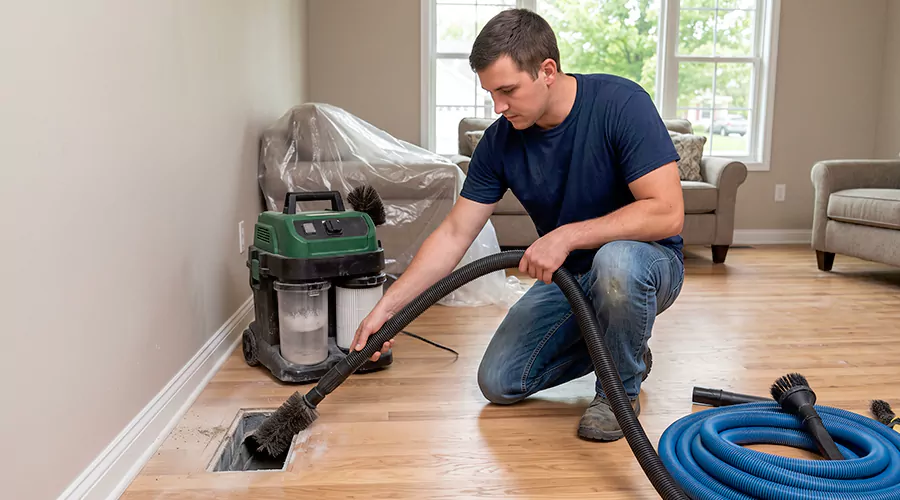
Air duct cleaning typically costs $25 to $50 per supply vent in the United States in 2026, with approximately $35 per vent used as a common planning average. Return air vents may cost $40 to $75 each when priced separately. However, these rates are not universal because many professional cleaners quote a flat price for the entire HVAC system rather than charging for each opening.
Per-vent pricing is useful because homeowners can count the visible registers before requesting an estimate. Each supply opening connects to a branch that delivers conditioned air, while return grilles draw room air back toward the HVAC equipment. The number of these connections helps contractors estimate how much of the system must be accessed.
However, the visible vent count does not describe the complete duct network. Main supply and return trunks, plenums, and equipment components may require additional cleaning when contamination has been documented. A quote based only on the number of registers may therefore exclude important parts of the system.
Understanding how per-vent prices are calculated helps homeowners estimate their budgets and compare contractors using different pricing methods. It also helps distinguish a complete duct-cleaning service from one that cleans only the removable covers.
What Is the Average Air Duct Cleaning Price per Vent in 2026?
Published 2026 U.S. consumer pricing guides commonly place supply duct cleaning between $25 and $50 per vent. Angi reports approximately $35 as an average per-vent planning figure. HomeGuide and This Old House also describe higher charges for return vents under certain pricing arrangements.
The difference between supply and return pricing reflects the fact that return openings may connect to larger duct passages. However, not every contractor uses separate rates. Some include all returns in a fixed whole-system package.
| Vent Type | Typical 2026 Cost per Vent |
|---|---|
| Supply air vent | 25–50 |
| Average supply-vent planning rate | Approximately $35 |
| Return air vent | 40–75 |
| Removable grille cleaning only | Usually DIY or part of another service |
| Whole HVAC system cleaning | Often quoted as a separate package |
These figures apply to professional cleaning estimates that use vents as the pricing basis. They should not automatically be interpreted as the cost of wiping a visible grille. A service that cleans only the cover involves far less work than cleaning the connected duct branch.
The rate also does not confirm whether the contractor includes the main trunks or air handler. Those details should be established before calculating the full price.
How Do You Calculate Air Duct Cleaning Cost per Vent?
A basic per-vent estimate is calculated by multiplying the number of vents by the contractor's price for each opening. If supply and return vents have different rates, each category should be calculated separately. The two subtotals are then added together.
The simplest formula is:
Estimated cleaning cost = (Supply vents × Supply rate) + (Return vents × Return rate)
For example, consider a home with twelve supply vents and two return grilles. If the contractor charges $35 per supply vent and $55 per return, the calculation is:
12 supply vents × $35 = $420
2 return vents × $55 = $110
Estimated total = $530
This result assumes that the quoted per-vent rates cover the intended cleaning scope. It does not automatically include a separate equipment setup fee or specialized contamination work. Contractors should identify any additional charges before the estimate is treated as complete.
Example Costs for Different Vent Counts
The following table uses the published ranges of $25 to $50 per supply vent and $40 to $75 per return vent. It shows how the number and type of openings affect a per-vent estimate.
| Supply Vents | Return Vents | Calculated Cleaning Range |
|---|---|---|
| 6 | 1 | 190–375 |
| 8 | 2 | 280–550 |
| 10 | 2 | 330–650 |
| 12 | 2 | 380–750 |
| 16 | 3 | 520–1,025 |
| 20 | 4 | 660–1,300 |
These figures are examples based on published per-vent prices, not national average invoices for homes with these layouts. Actual quotes may be lower or higher because companies use different methods. A whole-system package can also produce a different price from the mathematical total shown.
The examples make one point clear. Counting only supply vents can underestimate the estimate when the contractor prices return grilles separately. Homeowners should identify both types before requesting quotes.
What Counts as an Air Vent for Cleaning Prices?
An air vent is generally counted as an individual supply register or return grille connected to the duct system. However, companies may define their pricing units differently. Some charge per visible grille, while others count individual duct openings or include returns as separate larger components.
Understanding the distinction prevents confusion when the technician arrives and finds more openings than expected.
Supply Air Vents
Supply vents deliver heated or cooled air into rooms. They may be located in ceilings, walls, or floors depending on the home's construction. A bedroom may contain one supply register, while a larger living area may have several.
When counting supply vents, record each separate opening rather than simply the number of rooms. A house with four bedrooms may have more than four supply vents because hallways and common rooms also require airflow. This is why room count alone is not a reliable cleaning estimate.
Return Air Vents
Return vents draw air back toward the HVAC equipment. They are often larger than supply grilles and may be located in hallways or central areas. Some homes have one major return, while others contain several distributed return openings.
Return vents should be counted separately because some contractors use a higher rate for cleaning them. A large return grille does not always correspond to the same amount of work as a small supply branch. The connected duct's size and layout influence the cleaning method.
Main Ducts and Plenums
Main ducts and plenums connect the individual branches to the HVAC equipment. They may contain deposits that cannot be removed simply by cleaning through each room's grille. Whether these components are included is a major factor in judging the completeness of a per-vent quote.
A contractor may charge one price covering all branches and trunks. Another may advertise a low per-vent rate but add separate charges for main ducts. The estimate should state how those components are handled.
HVAC Equipment Components
The blower and other HVAC components are not ordinarily counted as room vents. Some duct-cleaning packages include them when appropriate, while others offer equipment cleaning separately. The scope should reflect which components are affected by the contamination.
A contractor should not assume that every component requires cleaning simply because the supply ducts contain dust. The need for each task should be established through inspection and the agreed work description.
How Much Does Air Duct Cleaning Cost for 8, 12, 16, or 20 Vents?
A straightforward estimate can be calculated using only supply-vent pricing. This is useful for comparing published national figures, although it does not account for separately priced returns. At $25 to $50 per supply vent, the total increases as more openings are included.
| Number of Supply Vents | Cost at $25 Each | Cost at $35 Each | Cost at $50 Each |
|---|---|---|---|
| 8 | $200 | $280 | $400 |
| 10 | $250 | $350 | $500 |
| 12 | $300 | $420 | $600 |
| 16 | $400 | $560 | $800 |
| 20 | $500 | $700 | $1,000 |
| 24 | $600 | $840 | $1,200 |
These amounts are mathematical estimates based on supply-vent prices. They do not mean that every home with twenty vents will receive a $1,000 bill. A contractor offering complete-system pricing might quote a different amount after inspecting the duct layout.
A final estimate may also reflect whether the vents are connected to one or several HVAC systems. Separate systems often require additional setup and cleaning work.
Why Do Return Vents Sometimes Cost More to Clean?
Return vents can connect to larger passages that carry air toward the HVAC equipment. These ducts may collect deposits from air moving through the occupied rooms. Their size and accessibility can influence cleaning time and equipment selection.
For example, cleaning a large return trunk may require more work than cleaning a short, narrow supply branch. However, the visible size of the grille does not always reveal the amount of ductwork behind it. The actual cleaning scope should determine the rate.
Some contractors avoid this distinction by including return ducts within a whole-system price. Others charge separately because they treat returns as a different part of the job. Neither method is automatically incorrect when the total scope is clearly described.
The important question is whether the return system will actually be cleaned when appropriate. A per-vent quote that excludes the returns should not be mistaken for complete-system cleaning.
Do Companies Charge a Minimum Fee for Air Duct Cleaning?
Many cleaning services have minimum project or setup charges because professional equipment must be transported and prepared before work begins. Even a small home may require vacuum collection equipment and several access points. This can make a simple per-vent calculation lower than the company's actual minimum invoice.
For example, a home with only six supply vents might produce a mathematical estimate of $150 to $300 using published rates. A contractor may still charge a higher minimum for a complete-system service. The minimum should be disclosed before the appointment.
Some companies also apply a base charge for the main ducts or equipment setup. Others include those tasks in the per-vent amount. These pricing methods should not be combined unless the quote clearly identifies separate work.
Ask whether the per-vent rate is the complete price or an additional charge on top of a minimum service fee. This prevents misunderstandings when the final total differs from the advertised number.
Is Per-Vent Pricing Cheaper Than Flat-Rate Duct Cleaning?
Per-vent pricing is not automatically cheaper than a flat-rate package. The relative price depends on how many openings a home contains and what the contractor includes. A small system may benefit from a per-vent rate, while a larger system may receive a competitive whole-house quote.
Angi reports typical residential air duct cleaning costs between $271 and $509 in 2026, with an average near $390. HomeGuide reports a broader whole-house range of $450 to $1,000. These figures represent different project scopes and pricing samples.
| Pricing Method | Typical Calculation | Main Consideration |
|---|---|---|
| Per supply vent | 25–50 each | Number of supply branches |
| Separate return pricing | 40–75 each | Return duct scope |
| Per square foot | Commonly 0.20–0.40 | Total home size |
| Flat whole-system package | Approximately 271–509 for many projects | Defined systems and components |
| Larger whole-house service | 450–1,000 in broader estimates | Complexity and scope |
A flat quote can be attractive when it includes the complete supply and return system. However, it may exclude equipment components that another provider includes. The fairest comparison uses written estimates for the same work rather than simply selecting the lowest pricing formula.
How Does House Size Affect Per-Vent Cleaning Costs?
Larger homes often contain more supply and return openings, which can increase the total under per-vent pricing. However, the relationship is not exact. Two homes with the same floor area may have different HVAC layouts and numbers of systems.
A single-story home may distribute air through relatively accessible attic ducts. A multistory home could contain concealed vertical passages or separate air handlers. The amount of work is therefore affected by the duct configuration as well as the visible vent count.
Some contractors use home square footage as an alternative pricing method. Published estimates commonly range from $0.20 to $0.40 per square foot under one whole-house cleaning model. This estimate should not be added to a per-vent calculation unless the contractor explicitly identifies a separate service.
For the most accurate starting point, count actual vents and identify how many heating and cooling systems serve the property. These two details allow contractors to provide more meaningful estimates.
What Factors Can Increase the Price per Vent?
A published per-vent rate is typically a starting point. Actual cleaning difficulty can affect the amount a contractor charges. Delicate duct materials and difficult access can increase labor even when the number of openings remains unchanged.
Flexible or Internally Insulated Ducts
Flexible ducts require cleaning methods that do not tear their thin internal liners. Fiberglass duct board and internally insulated metal ducts also require careful handling. A stiff brush suitable for sound sheet metal may damage these materials.
The provider should identify the duct construction before selecting a method. When material is wet or moldy, replacement may be more appropriate than ordinary cleaning. These conditions should be priced separately from routine dust removal.
Difficult Access
High ceiling registers and concealed duct branches can require additional labor. Some systems need temporary access openings to reach their main passages. Those openings must be restored after cleaning so the ducts remain airtight.
A contractor should explain whether access work is included in the per-vent rate. If the entire system cannot be cleaned through the existing openings, the method and price may need adjustment.
Heavy Debris
Substantial construction dust or other deposits may require additional cleaning time. However, the amount of debris should be documented before a contractor adds charges. Ordinary surface dust on a grille is not proof that the entire branch contains heavy contamination.
Aggressive cleaning should not be used simply because a vent appears dirty. The technique must suit the duct material and actual condition.
Multiple HVAC Systems
Separate air handlers may require individual cleaning setups. Each system can contain its own main ducts and returns. A house with two systems may therefore cost more than one with the same number of vents served by a single unit.
The estimate should identify which systems are included. A contractor should not advertise cleaning every vent while excluding one of the property's HVAC systems without making that limitation clear.
Are Air Duct Cleaning Add-Ons Included in the Per-Vent Price?
Not necessarily. Per-vent pricing may cover only the branches connected to supply or return openings. Video inspection or equipment cleaning can be separate services, depending on the contractor.
Typical published 2026 pricing examples include:
| Additional Service | Indicative Cost |
|---|---|
| Video duct inspection | 70–130 |
| HVAC inspection | 100–300 for some projects |
| Furnace-related cleaning | 60–150 |
| Dryer vent cleaning when bundled | Around $100 |
| Separate dryer vent cleaning | 100–170 in some estimates |
| Air duct repair | Approximately 200–800 for some repairs |
These prices describe different services and should not automatically be added to the per-vent total. A whole-system package may already include some of the listed work. The estimate should identify actual exclusions rather than leave them unclear.
Mold remediation and pest removal require their own assessment when applicable. They are not routine add-ons that every home needs. A contractor should document the condition before proposing specialized treatment.
How Can You Count Air Vents Before Getting a Quote?
Counting vents yourself is a practical way to prepare for a professional estimate. It helps you identify the number of supply and return openings and reduces the chance of unexpected charges. The count should include every relevant room and common area served by the system.
Follow these steps:
- Walk through each room and identify supply registers.
- Count wall, floor, and ceiling supply openings separately.
- Identify the larger return grilles.
- Record supply and return totals in separate categories.
- Check hallways and other shared spaces for additional openings.
- Determine whether the home has more than one HVAC system.
- Identify vents that are difficult to reach.
- Note unusual visible damage or debris.
- Provide the totals when requesting estimates.
- Ask the contractor to verify the count before beginning.
A supply vent usually releases conditioned air into a room, while a return draws air back toward the equipment. If the function of an opening is uncertain, ask the HVAC technician to identify it. Do not change damper settings or disconnect ductwork while counting.
The count should be confirmed during the contractor's inspection. It is intended to help estimate the job, not replace an assessment of the system's actual configuration.
What Should Be Included in a Per-Vent Cleaning Quote?
A per-vent quote should describe the cleaning method and identify the parts of the system included in the rate. Cleaning a grille cover is not equivalent to cleaning the attached duct branch. A meaningful quote should distinguish these tasks.
Ask whether the contractor will use controlled vacuum collection and tools suitable for the duct material. The work should not release substantial dust into occupied rooms. Any temporary access openings must be closed after the cleaning is completed.
The quote should also identify whether main ducts and relevant equipment components are included. A low per-vent rate may appear attractive but become expensive when required components are charged separately. Written scope details help reveal these differences before work begins.
Is Cleaning Every Air Duct Vent Necessary?
Cleaning every vent is not automatically necessary merely because a homeowner notices dust on one grille. Ordinary surface deposits are common and can often be removed through household cleaning. The internal duct condition should be evaluated before a professional whole-system cleaning is recommended.
The Environmental Protection Agency advises considering duct cleaning when substantial visible mold is present in suitable hard-surface components, vermin infestations occur, or excessive dust and debris are released from supply registers. It does not recommend routine cleaning on a fixed schedule. These conditions are more meaningful than the number of vents in a house.
When a system is genuinely contaminated, the cleaning plan should account for affected connected components rather than selecting random vents. Leaving significant contamination elsewhere in the system may allow cleaned areas to become dirty again. The appropriate scope should follow the actual findings.
How Can You Avoid Per-Vent Cleaning Scams?
Very low advertised per-vent prices may not include the equipment setup or main ducts. Some companies promote a limited service and add substantial fees after arriving. A clear written quote reduces the likelihood of this problem.
Ask these questions before booking:
- Is the price for the grille cover or the entire connected branch?
- Are return vents priced separately?
- Is there a minimum service charge?
- Are the supply and return trunk lines included?
- How many HVAC systems are covered?
- Does the rate include equipment setup and vacuum collection?
- Are there charges for difficult access?
- Will access openings be restored?
- What conditions would require additional work?
- How will the finished cleaning be verified?
Be cautious of claims that the EPA certifies duct-cleaning companies. The agency does not certify or endorse such businesses. Contractors should demonstrate their actual qualifications and explain their proposed cleaning methods.
Comparing several written estimates is more useful than choosing a contractor solely from a low price per vent. The total should correspond to a defined cleaning scope and the condition of the HVAC system.
When Should You Hire a Professional?
Professional cleaning may be appropriate when substantial deposits extend into the ductwork or when specific contamination has been documented. Concealed systems require equipment that can collect loosened particles and protect duct materials. A qualified provider should inspect the system before determining the work required.
When the problem is limited to dusty vent covers, household vacuuming is usually sufficient. A professional duct-cleaning appointment should not be necessary for every ordinary surface deposit. Matching the service to the actual condition helps control costs.
If suspected mold or moisture damage is present, the source should be evaluated first. Wet or moldy internal fiberglass insulation generally requires replacement rather than cleaning. The proposed work should address the underlying problem as well as any affected duct components.
How Can You Reduce Air Duct Cleaning Costs?
The most effective way to control future expenses is to maintain the HVAC system and avoid unnecessary professional cleaning. Regular filter replacement and prompt repair of damaged return connections can reduce unwanted particle entry. Keeping ductwork dry also limits conditions that contribute to moisture-related contamination.
Vacuum visible grilles during ordinary household cleaning rather than waiting for thick deposits to form. Protect openings during dusty renovation work and avoid running the HVAC system during activities that produce large amounts of airborne debris when practical. These measures help reduce the chance of substantial deposits entering the system.
When professional cleaning is warranted, request a detailed whole-system quote alongside any per-vent estimate. Comparing the full scope may reveal that a package is more economical. It also reduces the likelihood of paying separately for connected components that should be addressed during the same visit.
Conclusion
Air duct cleaning typically costs $25 to $50 per supply vent in 2026, with approximately $35 commonly used as a planning average. Return vents may cost $40 to $75 each when priced separately. The total depends on vent counts and whether main ducts and equipment components are included. Per-vent pricing is useful for estimating costs but should not replace a clearly defined whole-system quote. Count your supply and return vents separately before comparing professional cleaning estimates.